

Blog · 7 April 2022
Vigilance and its importance for self-defense
By learning to observe your surroundings and respond appropriately to what you see, you gain a great degree of control over your circumstances.

According to Lieutenant Colonel Jeff Cooper, recognised as the father of modern firearms technique, the most important factor for surviving a lethal confrontation is not fighting skills or available weapons, but rather the mindset and state of alertness we are in at the moment of the incident.
By learning to observe your environment, constantly evaluate it, and respond appropriately to what you see, you can gain a great degree of control over your circumstances. This means you need to get used to moving up and down a “scale of awareness” so that you can match your level of alertness to the level of threat. This scale ranges from a state of oblivion and unpreparedness to one in which, if necessary, you can deal with lethal violence. It is important to “slide” between these states as the situation and circumstances change.
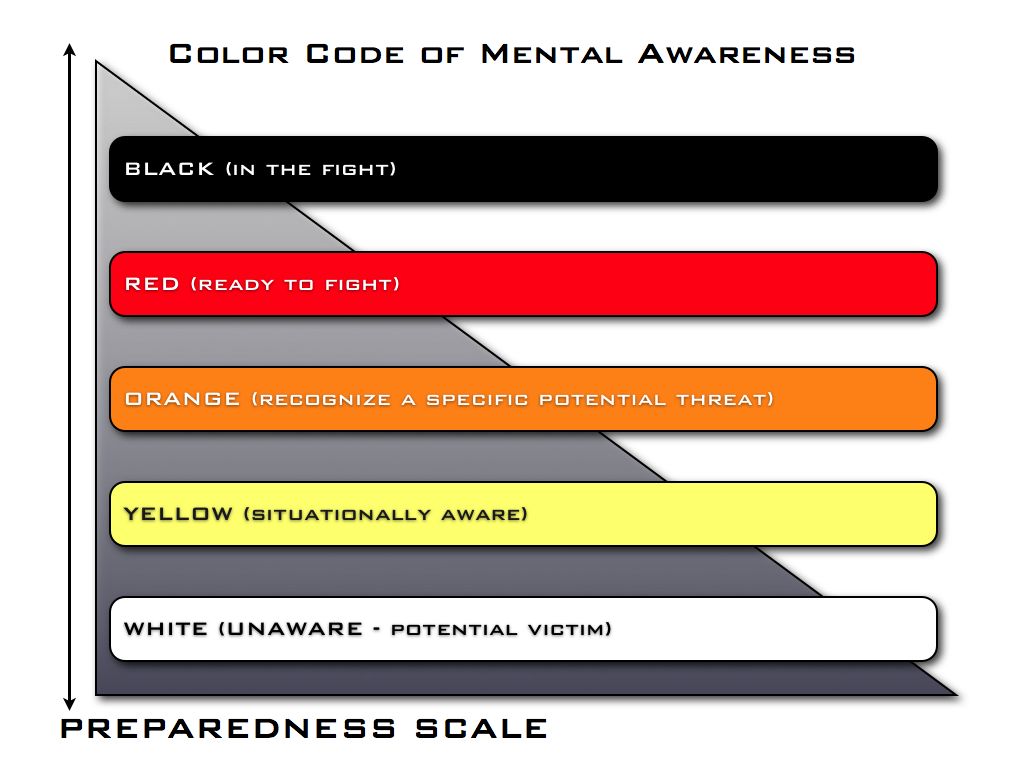
White
Unaware and unprepared. “Daydreaming” or “preoccupied,” indifferent to a possible threat. If you are attacked while in White, the only thing that can save you is your attacker’s mistake or ineffectiveness.
Your main enemy is reaction time. If you are not aware of your surroundings and fail to notice the suspicious individual, they can overwhelm you before you can defend yourself effectively. If you are attacked while in “White,” you will need several seconds just to realise what is happening and respond. In reality, that time simply does not exist.
When would it be acceptable to be in “White”? Ideally, only when you are in your own home with the doors locked (and the alarm activated). The moment you leave home, move up to the next level — “Yellow.”
Yellow
Relaxed alert. There is no specific threat. You do not expect to be attacked; you are simply aware of the fact that the world is a potentially unfriendly place and that “today could be the day I need to defend myself.” You are alert and aware of your surroundings. You are difficult to surprise, so you do not become an easy victim!
You should always be in “Yellow,” at least whenever you are in an unfamiliar environment or among people you do not know. You can stay in Yellow for extended periods — you take in and process information from your surroundings in a relaxed but alert manner. When something catches your attention, evaluate it. If it is not a threat, move on. If it is a possible threat, begin to prepare mentally to deal with it.
Anything or anyone in your immediate vicinity that is unusual, out of place, or outside the normal pattern should be regarded as potentially dangerous until you have had the chance to evaluate it. When you notice something truly wrong, move immediately to the next level — “Orange.”
Orange
Specific alert. Something is not right and it has caught your attention. You shift your primary focus to determine whether a threat exists. The difference between Yellow and Orange is this specific target of your attention. Your mindset shifts to “I may have to defend myself today against that person,” concentrating on the specific target that triggered the alert. When you move into “Orange,” you begin to focus your attention on the individual who caught your eye, but keep your guard up — you don’t want to be caught off guard by their associates. You begin to observe and assess their intentions. Once you realise there is no threat, remove them from focus and return to Yellow.
As you evaluate a situation, you begin to play “What if …” in order to form a basic plan. If they act suddenly, having this plan in mind allows you to react quickly. In Orange condition, you set a mental trigger: “If that person does ‘X’, I will have to stop them.” If the threat turns out to be false, you can return to “Yellow.” If, after evaluating, you believe it is a real threat, then you reach the highest level — Condition “Red.” Having a scenario to act on already formed, you can move fast enough to resolve the problem.
Red
Red means “fight or flight.” It means stopping the danger or escaping. Your mental trigger (set during the “Orange” evaluation) has been activated. You must act now — decisively and aggressively.
The US Army also uses “Black” as the final phase of the colour system, although it was not originally part of Cooper’s Code.
Black
Catastrophic degradation of physical and mental performance. Condition “Black” is when you have not prepared for a violent encounter (mentally or through self-defense training) and your mind is now overwhelmed by stress, while both your mind and body are incapable of producing any realistic defensive response.
In essence, you become a victim through lack of planning or awareness of possible dangers. “Black” is NOT a scenario you want to be in! The natural response to sudden danger actually has 3 variants: fight, flight, or freeze. The inability to process the events unfolding around us overloads our nervous system and leaves us without any response.
In conclusion, you can significantly increase your personal security and safety by generally living in “Yellow,” in accordance with Cooper’s colour code.
TL;DR :)
It is important to note that this does not mean being paranoid and never leaving the house, or labelling everyone as an aggressor. The definition is “RELAXED alertness”! Staying consistently within the Yellow level and moving easily in and out of Orange is simply a state of mental awareness that must be practised until it becomes second nature. Naturally, this is something we learn and practise during self-defense training.
Photo by Leon Pauleikhoff on Unsplash